Moving out triggers a cascade of logistical challenges, but few moments create more anxiety than the final walkthrough with your landlord. Your security deposit—often representing $1,500 to $3,000 in committed funds—hangs in the balance, subject to subjective interpretation of a deceptively simple word: “clean.”
Most tenants lose portions of their deposit not because they neglected to clean, but because they cleaned according to the wrong standard. The gap between your perception of “spotless” and your lease’s contractual definition can cost hundreds of dollars in unexpected deductions. Whether you’re relocating across town or preparing for homeownership to secure better mortgage rates, understanding these financial tripwires becomes essential to protecting your investment.
This isn’t another generic checklist reminding you to scrub the oven or vacuum carpets. Instead, we’ll expose the strategic, psychological, and legal dimensions that typical move-out guides ignore: the contractual language that defines your obligations, the timing mistakes that sabotage even thorough cleaning efforts, and the documentation strategies that protect you from arbitrary deductions. For those in the Greater Toronto Area, services like professional move-out cleaning in Mississauga can bridge the gap between DIY efforts and lease-mandated standards.
Your Deposit Protection Strategy in 5 Points
- Contractual cleaning standards differ fundamentally from personal cleanliness preferences—your lease language determines what “clean” legally means
- Timing determines success: cleaning before furniture removal guarantees re-contamination during the moving process
- Photographic evidence with timestamps creates legal proof that protects against subjective landlord interpretations
- Landlords inspect invisible zones as diagnostic markers—door frame tops and window tracks reveal systematic neglect patterns
- Professional cleaning receipts function as contractual compliance insurance when DIY methods can’t match required standards
Misunderstanding What ‘Clean’ Actually Means in Your Lease
The fundamental disconnect in most security deposit disputes stems from a simple misconception: tenants believe “clean” reflects their personal standards of hygiene and order, when lease agreements define it through precise contractual language with legal implications. This gap between subjective perception and objective obligation creates the primary pathway for deposit deductions.
Your lease likely contains phrases like “professionally cleaned,” “broom-clean,” or “returned to move-in condition.” Each carries distinct legal meaning. “Broom-clean” typically requires removal of debris and basic sweeping, but permits dust accumulation and minor staining. “Move-in condition” demands restoration to the property’s state when you first occupied it, establishing your initial walkthrough photos as the baseline standard. “Professionally cleaned” imposes the highest bar—requiring methods, products, and results comparable to commercial cleaning services.

The cognitive bias of prolonged habitation compounds this confusion. After months or years in a space, you become desensitized to gradual deterioration—the slow yellowing of grout lines, the accumulation of cooking residue on cabinet exteriors, the dust settling into light fixture crevices. What feels “clean enough” to you represents the degraded baseline you’ve unconsciously accepted through daily exposure. Your landlord evaluates the same space against the pristine move-in standard, creating inevitable perception gaps.
Research confirms this disconnect has financial consequences. 68% of renters consider their security deposit amount reasonable, suggesting the majority accept deductions without recognizing they stemmed from preventable cleaning standard misalignments rather than legitimate damage.
The strategic solution requires treating your move-in documentation as your cleaning blueprint. Photograph every surface, fixture, and corner during your initial walkthrough with timestamp metadata enabled. These images establish the exact condition you’re contractually obligated to restore. If the grout was already dingy at move-in, you’re not responsible for restoration to pristine white. If window tracks contained debris in your initial photos, you’ve documented pre-existing conditions that can’t be charged against your deposit.
Contractual ambiguities create additional vulnerabilities. Phrases like “reasonable wear and tear” or “normal use deterioration” contain subjective interpretation space. Before initiating your final cleaning, submit written requests to your landlord for clarification on specific items: Are nail holes from picture hanging considered normal wear? Does carpet color fading from sunlight exposure qualify as acceptable deterioration? Securing written responses creates documentation that prevents post-departure standard shifts.
San Francisco Security Deposit Interest Rate Requirements
San Francisco’s Rent Ordinance demonstrates how cleaning standards vary significantly by jurisdiction, with financial implications that extend beyond simple cleanliness disputes. The city requires landlords to pay 5.2% interest on security deposits for 2024-2025, emphasizing the substantial financial stakes involved in deposit retention practices. Local regulations frequently specify different cleanliness standards beyond general “broom-clean” requirements, showing how lease language interpretation varies by location and must be understood within the context of applicable municipal laws. This jurisdictional variation reinforces why tenants cannot rely on generic cleaning advice—contractual obligations depend on the specific legal framework governing their rental agreement.
The distinction between DIY and professional standards becomes particularly relevant when your lease explicitly requires the latter. The table below illustrates why attempting to satisfy professional-grade obligations with household methods creates compliance gaps:
| Aspect | DIY Standard | Professional Standard |
|---|---|---|
| Equipment Used | Household cleaners, basic tools | Commercial-grade equipment, specialized products |
| Time Required | 6-12 hours for 2BR | 3-5 hours with team |
| Areas Covered | Visible surfaces only | All surfaces including hidden zones |
| Documentation | Self-certification | Professional receipt as proof |
Cleaning Before the Final Damage Assessment
Timing represents one of the most overlooked variables in move-out cleaning success. The conventional approach—scheduling a thorough cleaning session several days before your move-out date—creates a systematic setup for failure that most tenants never recognize until their landlord points out fresh damage during the final walkthrough.
The premature cleaning trap operates through a predictable sequence. You dedicate a full day to deep cleaning your rental three days before departure, achieving genuinely impressive results. Then the moving process begins: furniture scrapes across freshly cleaned floors, cardboard boxes shed dust across spotless surfaces, dollies leave scuff marks on baseboards, and the chaos of relocation undoes hours of meticulous work. By move-out day, the property looks lived-in again despite your significant effort.
Professional cleaning operations recognize this sequencing problem. Industry data shows 40% efficiency gain when scheduling cleaning after furniture removal rather than before, because teams can access all surfaces without obstacle maneuvering and avoid re-contamination from the moving process itself.
The two-phase strategy resolves this timing conflict. Phase one involves completing approximately 80% of deep cleaning tasks before your furniture exits—focusing on vertical surfaces, fixtures, and areas that won’t be impacted by furniture movement. This includes scrubbing walls, cleaning inside cabinets and closets, detailing bathrooms, and degreasing kitchen surfaces. Phase two executes immediately after furniture removal on your final day of access: comprehensive floor cleaning, baseboard inspection, final spot checks, and photographic documentation of the completed work.
The sequencing error extends beyond floor damage. Moving furniture reveals hidden areas you haven’t seen in months—dust accumulation behind refrigerators, carpet indentations under bed frames, wall discoloration behind dressers. Discovering these issues after you’ve already “finished” cleaning creates time pressure and incomplete remediation. The two-phase approach builds in a scheduled discovery period where you can address newly revealed problems systematically.
Synchronizing your final cleaning phase with the walkthrough inspection provides additional strategic value. Request that your landlord schedule the move-out inspection within 2-3 hours of your anticipated furniture removal completion. This proximity allows you to address any identified deficiencies immediately while you still have access, cleaning supplies on-site, and time before key return. The alternative—discovering issues via email days after departure—eliminates your ability to remedy problems and strengthens landlord justification for deposit deductions.
Skipping Documentation of Your Cleaning Efforts
Most security deposit disputes evolve into “he said, she said” credibility contests because tenants treat cleaning as a physical task rather than a legal transaction requiring evidentiary proof. Your memory of scrubbing grout for three hours holds zero weight in small claims court when confronted with your landlord’s timestamped photos showing dirty conditions—photos potentially taken weeks after your departure or of different areas entirely.
The documentation protocol transforms cleaning from an unverifiable claim into legally defensible fact. This requires systematic photographic evidence captured according to specific technical standards: enable timestamp and geolocation metadata on your phone camera, photograph every room from multiple angles showing overall condition, capture close-up detail shots of commonly disputed areas like appliances and fixtures, and document your work in progress to demonstrate thoroughness rather than just final state.
Understanding rental property obligations clarifies why this burden of proof falls disproportionately on tenants. While landlords must comply with specific legal requirements regarding deposit retention and documentation, tenants challenging deductions typically bear the evidentiary burden of proving the property met contractual standards at key return. Absent compelling documentation, adjudicators default to landlord credibility.
The cleaning completion report elevates documentation beyond simple photos. Create a written inventory following your lease’s cleaning checklist (if provided) or standard move-out requirements: list each room, enumerate specific tasks completed in that space, note products and methods used for major cleaning challenges, and include completion timestamps. Email this report to your landlord before or immediately upon key return, creating a timestamped digital record of your claimed completion state.
The joint inspection checklist provides the strongest protection when landlords cooperate. Request a walkthrough together where you jointly complete a written form evaluating each space and item. Both parties sign acknowledging either satisfactory condition or specific deficiencies noted in writing. This contemporaneous mutual agreement becomes nearly impossible to dispute later—if your landlord signed that the kitchen met standards, subsequent claims of inadequate cleaning face high credibility barriers.
Your move-in documentation completes the evidentiary framework. The before-and-after comparison neutralizes landlord attempts to charge for pre-existing conditions. If your move-in photos show cracked tile in the bathroom, identical cracking in move-out photos represents maintenance continuity rather than tenant damage. If window screens had tears when you arrived, your move-out photos showing the same tears demonstrate you didn’t cause deterioration. This comparative approach shifts the burden back to landlords to prove conditions worsened under your tenancy.
Ignoring the Invisible Zones Landlords Always Check
Landlords conducting move-out inspections don’t evaluate properties randomly—they follow psychological inspection patterns honed through years of tenant turnover, targeting specific diagnostic zones that reveal systematic neglect versus thorough cleaning. Understanding this predictable audit trail allows you to allocate effort strategically rather than exhaustively cleaning low-priority areas while overlooking the triggers that prompt deposit deductions.
The signal-zone strategy relies on marker surfaces that function as cleanliness proxies. When landlords find dust accumulation on top of door frames, they infer comprehensive neglect rather than isolated oversight—reasoning that if easily accessible horizontal surfaces were ignored, hidden areas must be worse. Window track debris serves the same diagnostic function: these highly visible linear channels take minimal effort to clean, so their neglected state suggests insufficient overall effort.
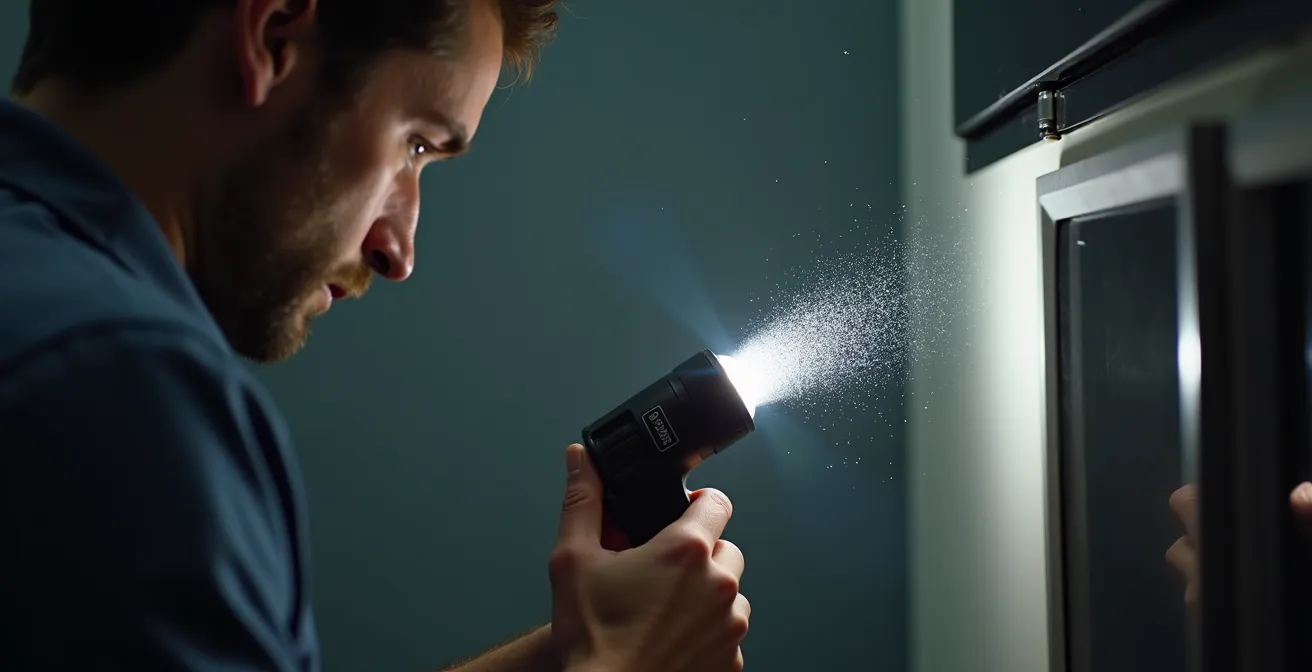
The inspection psychology operates through confirmation bias amplification. The halo effect in property evaluation means landlords who discover one significant deficiency actively search for additional problems—their mental model shifts from “this tenant maintained the property” to “this tenant was negligent” based on a single trigger finding. This cognitive bias explains why one visible oversight (dirty range hood) prompts microscopic scrutiny of grout lines, cabinet interiors, and light fixtures, resulting in compounding deductions.
Witness surfaces reveal long-term maintenance patterns that tenants cannot remediate during move-out cleaning alone. Tile grout that’s accumulated years of mildew, under-sink cabinet floors stained by slow plumbing leaks, toilet bases with permanent hard water rings—these conditions telegraph chronic neglect rather than acute move-out oversights. Landlords recognize that genuine deep cleaning produces evidence of attempt even when full restoration proves impossible: scrubbed grout shows color variation between cleaned and stained sections, demonstrating effort.
The legal distinction between normal wear and tenant damage becomes critical in dispute resolution. Normal wear encompasses deterioration from intended use over time without negligence: carpet traffic patterns in walkways, minor scuffing on walls near door handles, finish wear on frequently touched surfaces. Tenant damage reflects negligence, misuse, or maintenance failure: carpet stains from spills left untreated, wall gouges from furniture impacts, or extensive grime buildup from cleaning neglect. This distinction determines financial responsibility—landlords cannot legally charge for normal wear deterioration, but can recover costs for damage beyond expected aging.
Strategic priority targeting emerges from this inspection psychology. Focus disproportionate effort on high-visibility signal zones: tops of all door frames and baseboards, window sills and tracks, range hood exterior and filters, refrigerator top and behind/beneath appliance, bathroom exhaust fan grilles, light fixture interiors, and cabinet door exteriors especially near handles. These areas require perhaps 15% of total cleaning time but drive 60% of landlord impression formation during walkthroughs.
Key Takeaways
- Cleaning standards derive from lease contractual language, not personal preferences or subjective cleanliness perceptions
- Schedule comprehensive cleaning only after complete furniture removal to prevent re-contamination during the moving process
- Create timestamped photographic documentation of all cleaned surfaces to establish legal proof against arbitrary deductions
- Prioritize invisible diagnostic zones like door frame tops and window tracks that landlords use as systemic neglect indicators
- Professional cleaning service receipts provide contractual compliance proof when lease terms mandate professional-grade standards
Assuming DIY Cleaning Satisfies Professional Standards
The professional cleaning standard illusion represents perhaps the costliest assumption tenants make—believing that sufficient time, effort, and household products can replicate results that contractually require commercial-grade methods and equipment. This confidence persists until the final walkthrough reveals the gap between amateur thoroughness and professional-grade outcomes, at which point remedy opportunities have expired.
Lease clauses requiring “professional cleaning” or “professionally cleaned condition” impose specific legal obligations distinct from general cleanliness requirements. These terms reference industry-standard methods: hot water extraction for carpets rather than vacuum-only treatment, commercial degreasers for kitchen surfaces rather than household spray cleaners, and specialized equipment like steam cleaners and rotary scrubbers rather than manual scrubbing. When your lease contains such language, DIY methods create contractual non-compliance regardless of effort invested.
The return on investment calculation makes the professional service decision financially rational rather than optional. Consider typical scenarios: a $300 professional move-out cleaning service protects a $2,000 security deposit against a landlord claiming $800 in cleaning deductions. Even if you could theoretically achieve 80% of professional results through DIY effort, that remaining 20% gap justifies the entire deposit retention under contractual professional standard requirements. The math favors guaranteed compliance over optimistic amateur attempts.
Three specific tasks demonstrate where DIY methods systematically fail to meet professional standards. Carpet steam cleaning appears deceptively simple—rent a machine, apply solution, extract water—but improper technique leaves soap residue that attracts rapid re-soiling, creating worse long-term appearance than pre-cleaning state. Professional operators use commercial extractors with superior suction power and multi-stage rinsing that consumer rentals cannot replicate. Range hood degreasing involves disassembling components and using industrial solvents to dissolve carbonized residue that household degreasers merely smear. Descaling requires acid-based professional products and application knowledge that prevents surface damage while removing mineral deposits—household vinegar solutions prove ineffective against severe buildup.
The professional service receipt functions as legal insurance beyond just task completion. When disputes arise, this dated receipt from a licensed cleaning company creates presumption of contractual compliance—your landlord must overcome documented evidence of professional service to justify cleaning-related deductions. Courts and mediators view such receipts as credible third-party verification, whereas tenant claims of DIY thoroughness represent unverifiable self-serving statements. This evidentiary weight alone often justifies the service cost.
The hybrid approach optimizes cost and compliance for tenants whose leases don’t explicitly mandate professional service. Handle routine tasks yourself—wall washing, surface cleaning, organization, and debris removal—then engage professionals specifically for the high-skill tasks where amateur methods visibly fall short: carpet extraction, window cleaning, and appliance deep cleaning. This targeted professional engagement costs $150-200 rather than $300-400 for full-service cleaning, while still providing receipted proof of professional-grade work on the most scrutinized elements.
Frequently Asked Questions on Relocation Cleaning
What does “professionally cleaned” mean in a lease agreement?
“Professionally cleaned” establishes a contractual standard requiring methods and results equivalent to commercial cleaning services, not merely thorough DIY effort. This typically mandates specialized equipment like carpet steam extractors, commercial-grade cleaning solutions, and industry-standard techniques that exceed household cleaning capabilities. Your lease may specify particular services required (carpet extraction, window cleaning) or reference general professional standards, both creating legal obligations distinct from basic cleanliness.
When is the best time to schedule move-out cleaning?
Optimal timing follows a two-phase approach: complete 80% of deep cleaning before furniture removal, focusing on walls, fixtures, cabinets, and bathrooms that won’t be impacted by moving activities. Then schedule final comprehensive cleaning immediately after all furniture exits on your last day of access, addressing floors, baseboards, and newly revealed areas behind appliances. This prevents re-contamination from the moving process while ensuring complete surface access for final detailing.
What documentation should I provide to my landlord during move-out?
Comprehensive documentation includes timestamped photographs of every room and surface showing cleaned condition, close-up detail images of commonly disputed areas like appliances and fixtures, a written cleaning completion report listing specific tasks performed in each space, and receipts from any professional cleaning services engaged. Request a joint walkthrough inspection with signed checklist confirming condition, creating mutual agreement documentation that prevents later disputes about the property state at key return.
Can landlords legally deduct deposit funds for normal wear and tear?
No—landlords cannot legally charge tenants for deterioration resulting from ordinary use over time without negligence or damage. Normal wear includes carpet traffic patterns, minor wall scuffing near doors, paint fading from sunlight, and finish wear on frequently touched surfaces. Tenant financial responsibility covers damage beyond expected aging: untreated stains, holes beyond picture hanging nails, excessive grime from cleaning neglect, or breakage from misuse. Move-in documentation photographs establish baseline condition to distinguish pre-existing wear from tenant-caused damage.