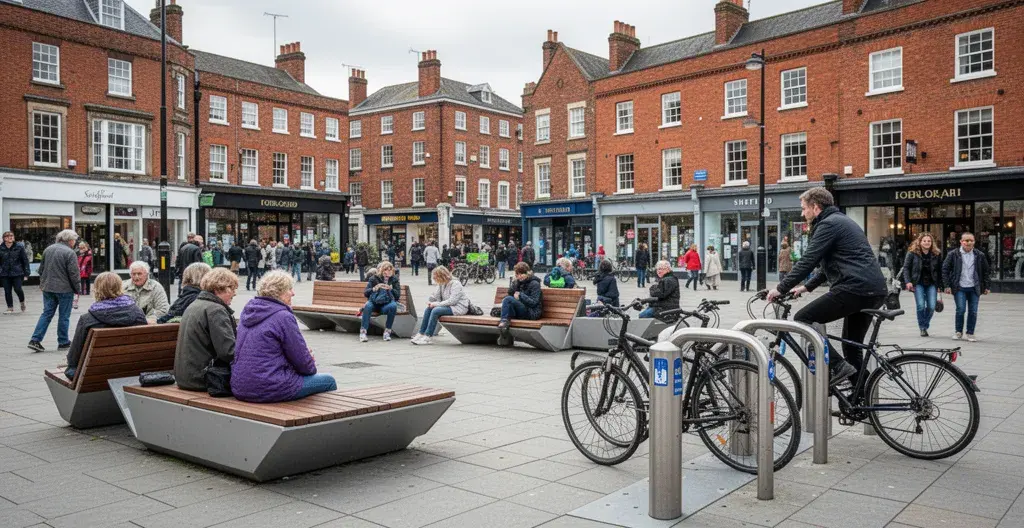
The UK street furniture market reached £664 million in 2024, with local authorities accounting for nearly 77% of that spend, according to UK street furniture market data 2024. That is substantial investment. The question is whether it delivers genuine transformation or simply adds more objects to ignore.
Street furniture transformation in 4 principles
- Empty furniture signals placement failure, not user disinterest—sight lines and natural surveillance matter
- Seating and shelter create destinations; bollards and railings enable safe flow
- Stainless steel benches last 25 years; timber alternatives may need replacement two to three times
- Accessibility compliance under BS 8300 and the Equality Act 2010 is non-negotiable for UK installations
Why empty benches signal a bigger problem
An empty bench is not proof that people do not want to sit. It is proof that someone installed a bench without understanding how people actually use space. In regeneration projects I have advised on across UK town centres, one recurring mistake stands out: installing seating without considering natural surveillance and sight lines. The result? Benches that remain empty because people feel exposed or unsafe.
This pattern varies by context. Suburban parks face different dynamics than busy high streets. But the principle holds. Research confirms that places with more urban furniture, especially seating appropriately located, are more likely to be visited and used socially, as documented in research on urban furniture impact.
The sight line test: Before specifying bench locations, sit in the proposed spot yourself. Can you see people approaching? Do you feel visible to passing pedestrians? If not, neither will your intended users.
Frankly, this approach fails more often than it succeeds when councils treat furniture placement as an afterthought. The 13% market growth from 2020 to 2024 shows investment appetite exists. What is missing is strategic thinking about where that investment lands.

The furniture that makes people stay
Seating and shelter do something other furniture categories cannot: they signal welcome. A bench says “stay.” A shelter says “wait comfortably.” Without these elements, public spaces become corridors—places people pass through rather than inhabit.
Research indicates provision of street furniture has significant positive effects on improving intensity level of social engagement within public space, including lingering, people-watching, and conversing, according to social cohesion street furniture study. Street furniture plays a significant part in fostering experiences of social integration and conviviality. This is not abstract theory. I see it repeatedly when well-placed seating transforms empty squares into gathering points.
Coordinated furniture ranges, such as those available at procity.eu, help councils achieve visual consistency across installations. Consistency matters because mismatched furniture reads as neglect, even when individual pieces are high quality.
When a market town got seating right
I worked with a district council team on a high street improvement scheme in a post-industrial market town in the Midlands. Empty shop frontages and declining footfall. Existing street furniture dated and mismatched—different bench styles from three decades of piecemeal additions.
Heritage concerns delayed modern bench installations by three months. Initial bollard placement blocked a weekly market’s delivery access. We reached a compromise design, but it required ongoing adjustment. Some residents still preferred the old Victorian-style furniture.
The lesson? The most transformative furniture installations are those where community buy-in happens before the first bench is unloaded from the lorry. We eventually achieved a 40% increase in measured dwell time, but that came after months of consultation, not despite it.
Watch out for the classic mistake of prioritising aesthetics over function. A beautiful timber bench positioned against a noisy road will gather dust. A simple steel bench facing a sunny, sheltered corner will gather people.
Safety, flow, and the furniture you barely notice
Bollards. Railings. Cycle stands. This is the furniture nobody photographs for design magazines, yet it fundamentally shapes how people move through space. Good examples become invisible—you notice only when they are wrong.
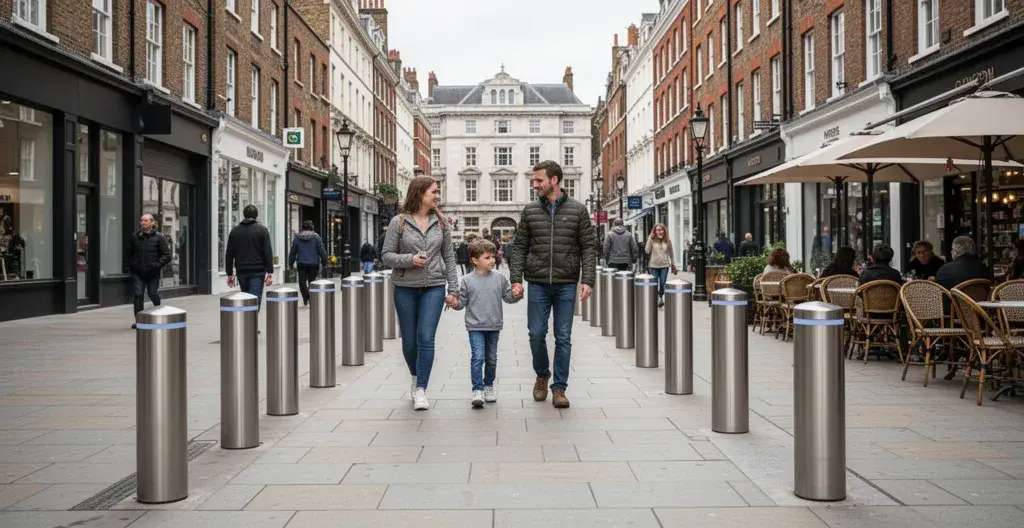
In the UK, local authorities have statutory powers under the Highways Act 1980 and Business and Planning Act 2020 to regulate street furniture placement, as outlined in Highways Act 1980 street furniture requirements. These powers exist precisely because poorly positioned flow furniture creates genuine hazards.
The bollard rule I always share with councils: If your bollards form a continuous line, you have created a wall. Space them to allow wheelchair and pushchair passage at regular intervals. Aim for 1.5 metre clear gaps every 10 metres minimum—accessibility is not optional, it is legal compliance under the Equality Act 2010.
Cycle parking deserves particular attention. Sheffield stands remain the standard for good reason: secure, intuitive, space-efficient. Position them where cyclists naturally want to stop—near entrances, visible from destinations—rather than tucked away where they will be ignored or, worse, where bikes become obstacles.
My view—and it is not universally shared—is that councils underinvest in flow furniture relative to seating. A high street with lovely benches but chaotic vehicle access remains a poor public space. Balance matters.
Making transformation last: materials and maintenance
A stainless-steel bench can last a quarter of a century, whereas wooden, stone, cement, or plastic alternatives may need repairing and replacing two to three times during the same period, according to stainless steel furniture durability analysis. That lifespan difference transforms lifecycle cost calculations.
Common material specifications for UK public realm include FSC-certified hardwoods, hot-dip galvanised or powder-coated steel, and UV-stable polyboards. Each has trade-offs. Hardwoods such as Iroko and oak remain preferred for high-traffic settings due to natural density and resistance. Steel offers longevity but requires appropriate protective finishes in our climate. Recycled plastics eliminate rot but can look synthetic.
Beware the false economy: Cheaper upfront materials requiring annual repainting or component replacement often cost more over 15 years than premium alternatives requiring minimal intervention. Always request lifecycle cost projections, not just purchase price.
Accessibility compliance under BS 8300 accessibility standards and the Equality Act 2010 is non-negotiable. BS 8300 defines best practices for designing accessible and inclusive environments and applies across the whole of the UK. These standards go beyond minimum requirements—and for good reason. Public furniture that excludes wheelchair users, people with visual impairments, or those with limited mobility is not just poor design; it is potentially unlawful.
Material choice fundamentally affects how long your investment delivers value—understanding durable materials for outdoor spaces helps inform these decisions before procurement begins.
Is your street furniture transforming or failing?
-
Are benches positioned with clear sight lines and natural surveillance?
-
Do shelters protect waiting areas people actually use?
-
Is there visible wear indicating regular use—or pristine surfaces suggesting avoidance?
-
Does cycle parking appear in convenient locations, or hidden where nobody bothers?
-
Do bollards protect pedestrians while allowing accessible passage?
Beyond street furniture, other structures can transform outdoor environments—explore pergola solutions for outdoor living to see how covered spaces create new possibilities for public and private settings alike.
Your questions about public space furniture
How long does quality street furniture last?
Stainless steel benches typically last 25 years with minimal maintenance. Timber and recycled plastic alternatives generally require replacement or significant repair two to three times within that same period, depending on climate exposure and usage intensity.
What accessibility standards apply to public seating in the UK?
BS 8300 provides detailed design guidance for accessible and inclusive environments, while the Equality Act 2010 establishes legal requirements. Together, these cover seating heights, armrest provision, clear approach space, and tactile differentiation for visually impaired users.
How do you choose between steel, wood, and recycled plastic furniture?
Consider lifecycle cost, not purchase price. Steel offers maximum longevity with appropriate anti-corrosion treatment. FSC-certified hardwoods provide natural warmth but require periodic maintenance. Recycled plastics resist rot and suit coastal or high-moisture locations but may appear less natural in heritage settings.
What maintenance does outdoor furniture require?
Steel furniture requires periodic inspection of protective coatings and reapplication every 5-10 years in exposed locations. Timber needs annual treatment for weather resistance. Recycled plastics typically require only cleaning. All furniture benefits from quarterly inspections for structural integrity and fixings.
How can councils justify street furniture investment?
Document baseline dwell time and footfall before installation, then measure again 6-12 months after. Research consistently links well-designed furniture to increased social engagement and longer visits. Combine usage data with lifecycle cost analysis showing 25-year value versus repeated replacement costs.
The next step for your public space
Transformation happens when furniture placement follows human behaviour rather than convenient installation points. Start with observation: where do people naturally pause, wait, or gather? Position seating and shelter there first. Let flow furniture—bollards, railings, cycle stands—respond to genuine movement patterns rather than theoretical pedestrian flows.
The councils I have seen succeed treat furniture as infrastructure, not decoration. They consult communities before specifying. They demand lifecycle cost projections. They audit existing installations ruthlessly.
What does your current public space furniture say about priorities? If benches sit empty and shelters shield nobody, the furniture is not failing. The strategy is.